Most people ordering a custom printed plastic bag obsess over the artwork and barely think about the two specifications that actually decide whether the bag works: how thick the film is and which plastic it is made from. Get those right and a bag carries its load, survives the trip, and makes your logo look sharp. Get them wrong and you either ship product in a bag that splits at the seam or overpay for industrial-grade film to hold a scarf. This is a plain-language walk through thickness and material, so you can hand a printer a specification instead of a guess.
What a “mil” actually means
Plastic bag thickness is measured in mils, and a mil is simply one-thousandth of an inch, or 0.001 inch. It is not a millimeter, which trips up a lot of first-time buyers; one mil is about 0.0254 mm, and for scale a human hair runs roughly two to three mils thick. A related unit is gauge, used mostly for thinner films, where 100 gauge equals one mil. So an 80-gauge film is 0.8 mil, and a 200-gauge film is 2 mil. When a supplier quotes gauge and you think in mils, divide by 100 and you are back on familiar ground.
Thickness matters because it drives puncture resistance, tear strength, and the way the bag feels in a customer’s hand. Thicker film resists sharp corners and heavy contents, and a heavier bag reads as more premium. The trade-off is cost and material use: every extra mil is more resin per bag. A useful rule from the trade is that when you are genuinely unsure, step up rather than down, because moving from, say, 2 mil to 3 mil adds only a little per bag but a lot of durability.
How thick is thick enough?
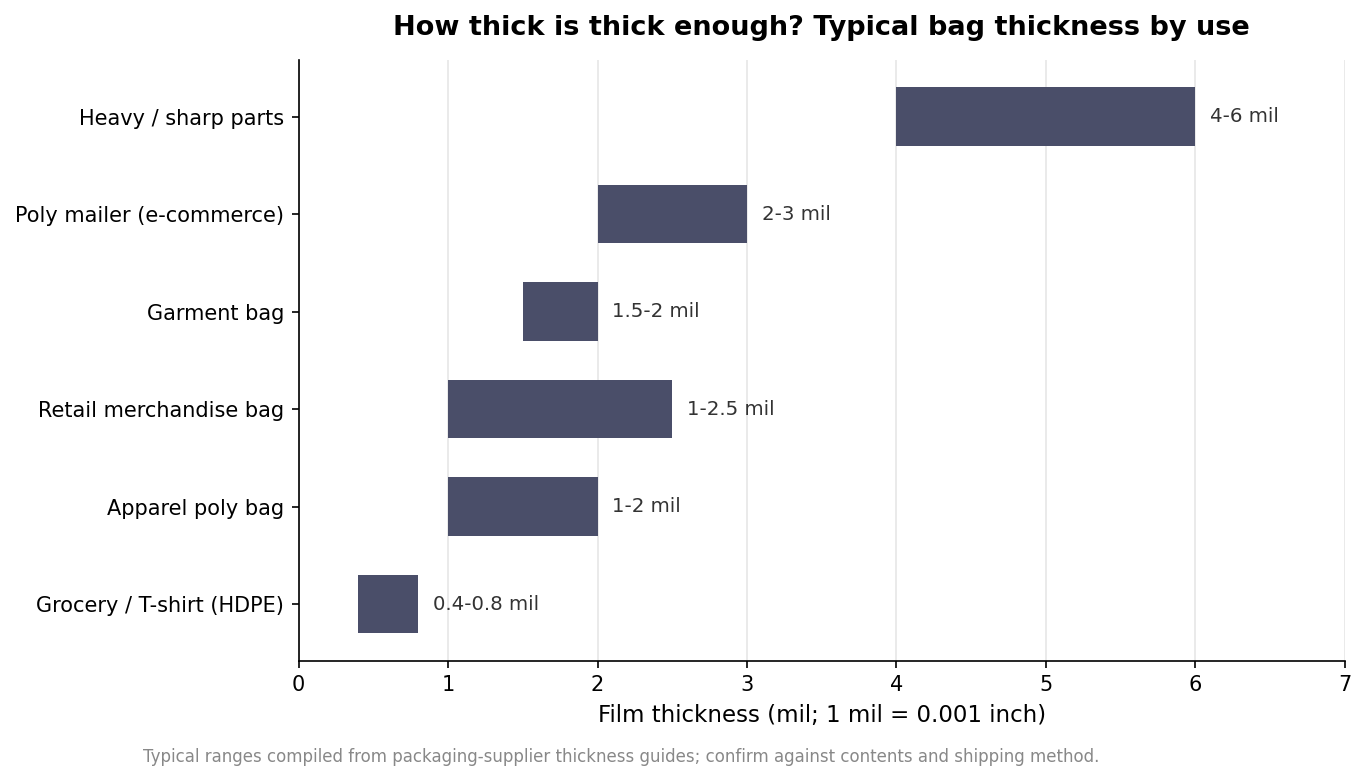
The right thickness follows the job. For everyday retail, a merchandise or apparel bag in the range of roughly 1 to 2.5 mil is plenty, since the contents are soft and light. A poly mailer for e-commerce typically lands around 2 to 3 mil, thick enough to survive a sorting facility without adding shipping weight. Garment bags sit near 1.5 to 2 mil, and thin grocery or T-shirt style carryout bags, which are made from a stiffer plastic, run much lighter, often well under 1 mil. When you are bagging hardware, tools, or anything with sharp edges, jump to 4 mil or beyond, with the heaviest industrial applications reaching 5 to 6 mil. One compliance note for anyone selling on major marketplaces: platforms such as Amazon require poly bags of at least 1.5 mil and a printed suffocation warning on bags above a certain size, so build that into your spec if it applies.
LDPE or HDPE: the two plastics you are choosing between
Almost every plastic bag is polyethylene, but it comes in two families that behave very differently. Low-density polyethylene, or LDPE, is soft, flexible, and glossy, with good clarity and a bit of stretch. It is what most custom poly mailers, merchandise bags, and premium shopping bags are made from, because it takes print beautifully and has a quality hand-feel. It also handles cold well, which is why freezer bags are LDPE; it flexes at low temperature instead of cracking. Its linear cousin, LLDPE, adds even more puncture and tear resistance and often gets blended in for mailers.
High-density polyethylene, or HDPE, is the crinkly, slightly hazy plastic of grocery and T-shirt bags. It is stiffer and has a higher strength-to-thickness ratio, so it can be made very thin and still carry a surprising load, which is exactly what a high-volume, low-cost carryout bag needs. The trade-off is that it is less clear and less soft, so it looks and feels more utilitarian. As a rule of thumb, choose LDPE when appearance and a premium feel matter, and HDPE when you want maximum strength at minimum thickness and cost.
Match the bag style to the job
Thickness and resin combine into a handful of common formats. A poly mailer is a sealed, tamper-evident shipping envelope, best for soft goods and apparel that do not need a box. A merchandise or die-cut handle bag is the flat retail bag you hand a shopper at checkout, prioritizing print area and a comfortable carry over ruggedness. A plastic shopping bag with reinforced handles carries more weight for grocery and big-box use, and a layflat or gusseted poly bag is the plain, open-top bag used to protect or bundle product before it goes in a box. Naming the format up front tells your printer the construction, the handle style, and the sealing method in one word, which removes most of the back-and-forth.
Printing, food safety, and locking down the spec
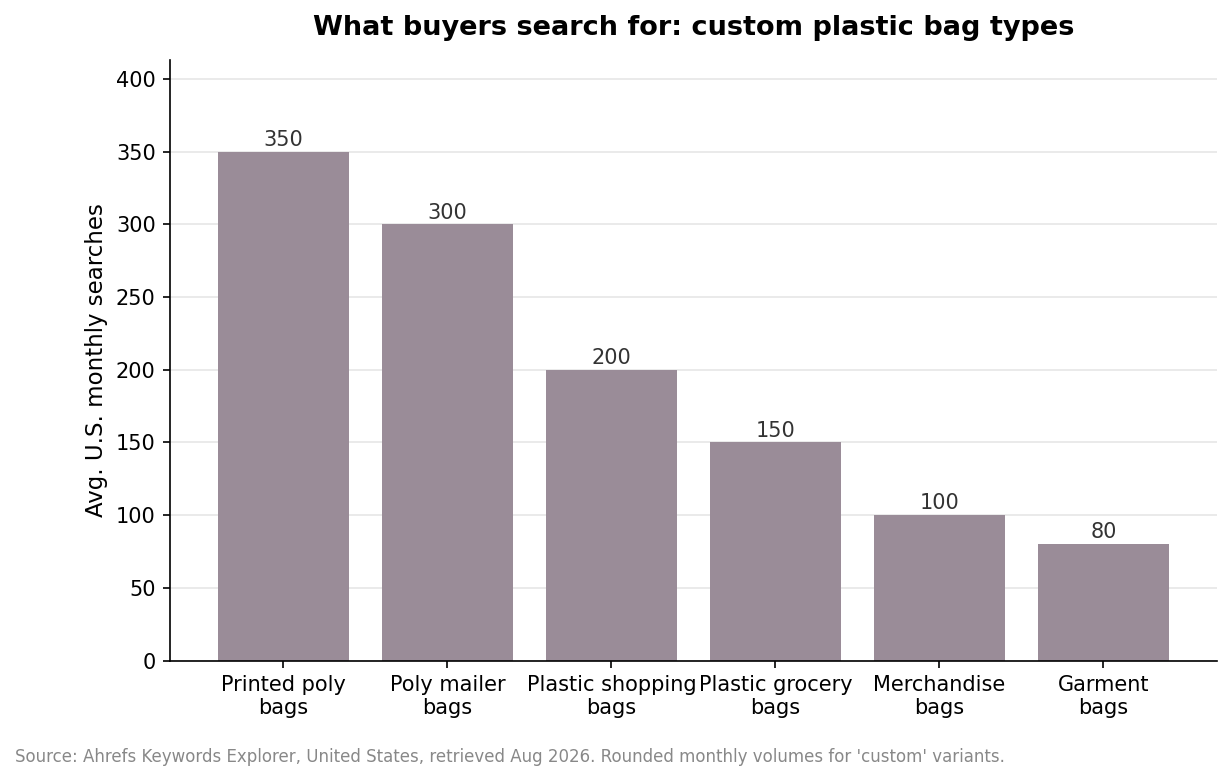
Custom graphics on poly bags are usually applied by flexographic printing, which lays one to several spot colors of ink directly onto the film and is well suited to logos and bold type. If your bag will touch food, specify a food-grade film made to the relevant FDA standards rather than a general-purpose bag, because not every polyethylene stock is certified for direct food contact. The demand chart below shows which custom bag types buyers are actually searching for, which is a decent proxy for where the everyday use cases cluster. Whatever you are ordering, a complete specification comes down to five answers: the bag style, the size, the thickness in mils, the resin, and the print. Pin those down and you will get bags that fit the product, survive the journey, and show off your brand exactly the way you intended.