For anyone buying bags in bulk, legality has quietly become as real a spec as gauge or print. A bag that is perfect on paper, the right size, a clean four-color print, a comfortable handle, can still be illegal to hand a customer in a growing list of states, and the rules are not the same from one state line to the next. Understanding the shape of the regulation before you place a large order is now part of speccing the bag, not an afterthought. This is general information rather than legal advice, and the rules change often, so treat what follows as a map of the landscape and confirm the current requirement for each place your bags will actually be used.
A patchwork, not a national rule
There is no federal plastic bag law, so the country is a mix of opposite approaches sitting side by side. As of 2025 and into 2026, roughly a dozen states have enacted a statewide ban on single-use plastic carryout bags: California, Colorado, Connecticut, Delaware, Hawaii, Maine, New Jersey, New York, Oregon, Rhode Island, Vermont and Washington. At the other extreme, a comparable group of states runs preemption laws that forbid their own cities from banning or taxing bags at all, keeping thin plastic firmly legal. Between those poles sit states with partial restrictions and states with no statewide rule, where local ordinances may or may not apply. The chart below sketches that split.
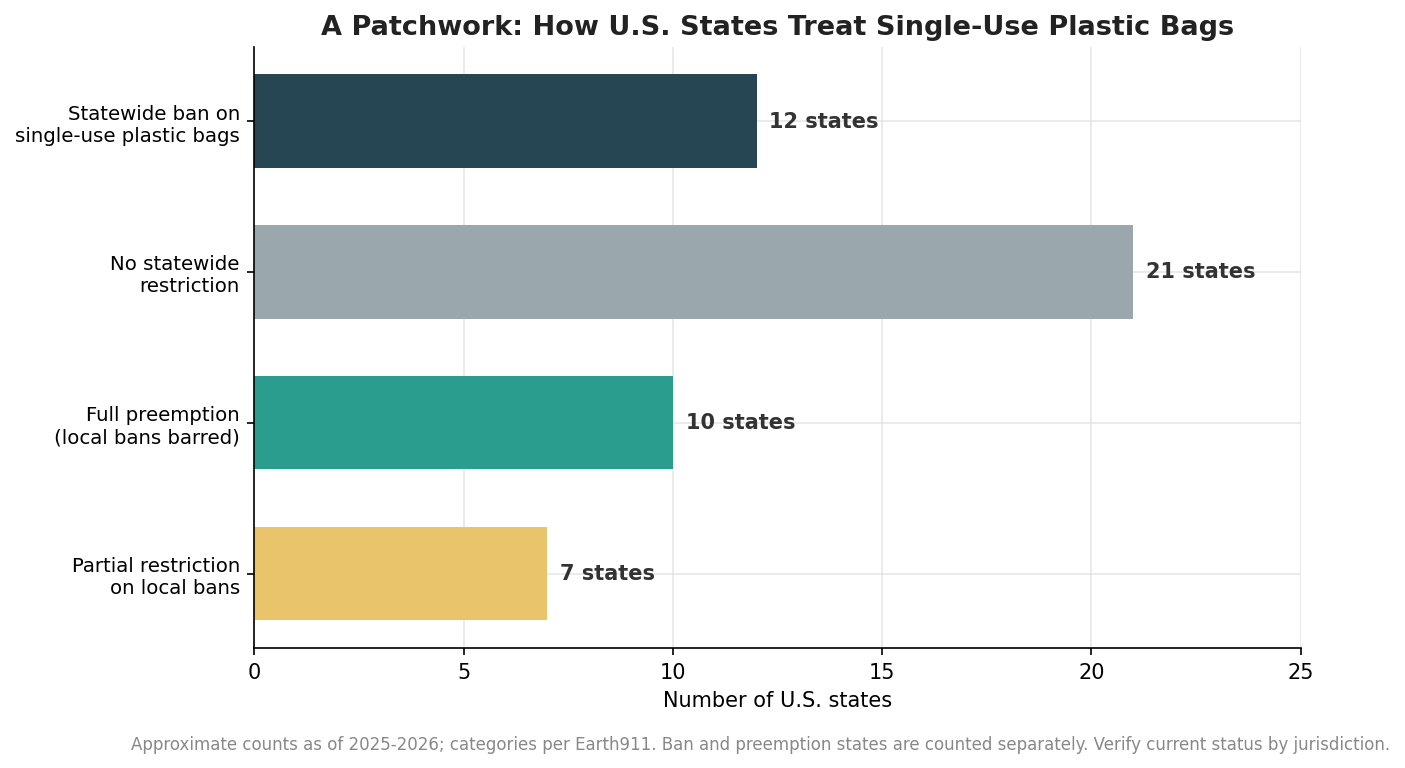
The practical consequence for a bulk buyer is that a single product can be a compliant staple in one market and contraband in another. If your bags ship to more than one state, or to a national customer, the binding constraint is the strictest jurisdiction in the set, not the average one.
The thickness line that laws draw
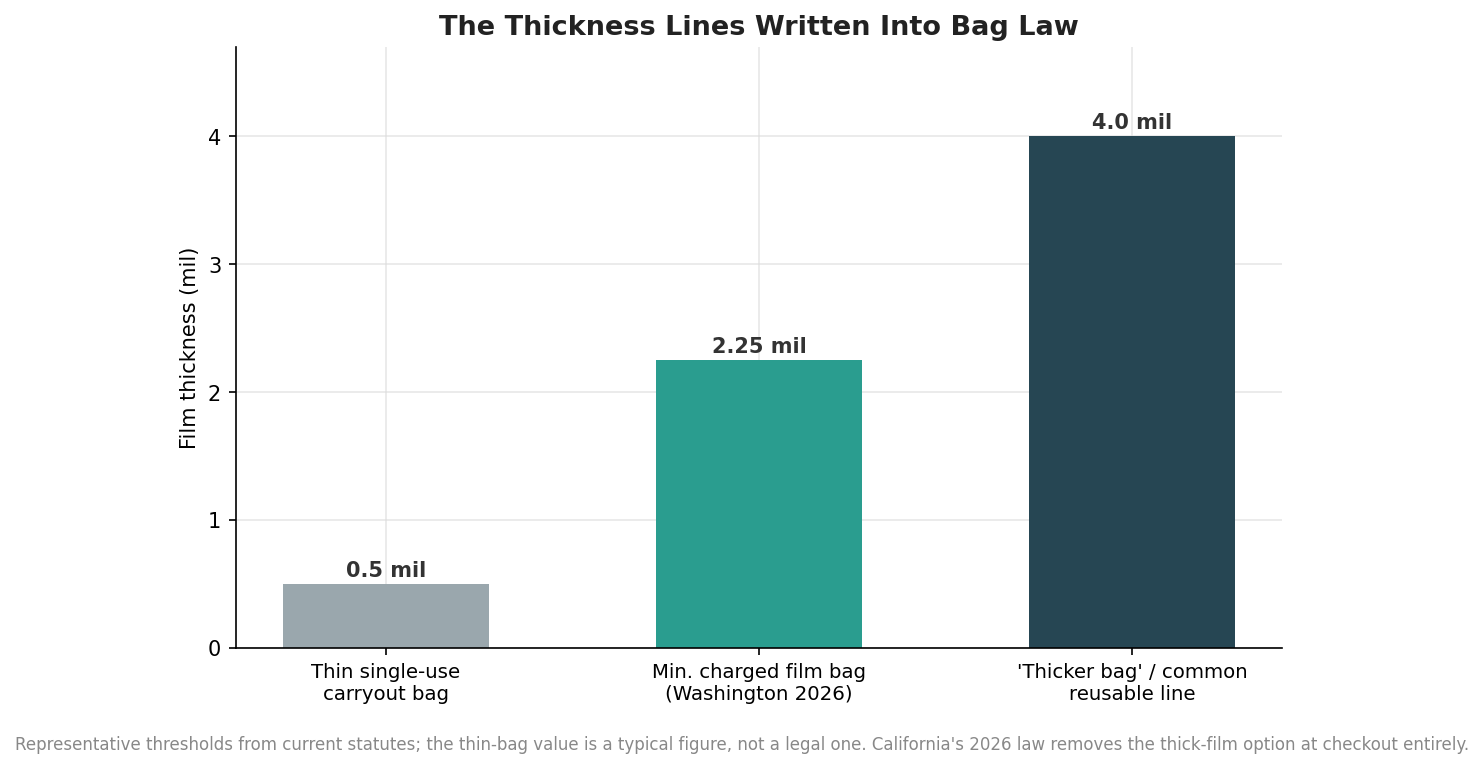
Where bags are regulated rather than banned outright, the law usually turns on film thickness measured in mils, one mil being a thousandth of an inch. The thin, crinkly carryout bag most bans target sits well under a mil. Many statutes then define a heavier film bag as the charged or reusable alternative above a set thickness. Washington’s rules taking effect in 2026, for example, set a minimum of 2.25 mil for a plastic film bag a retailer can provide for a fee, and treat bags of 4 mil or thicker as a separate, higher-fee category. Those two numbers, 2.25 and 4 mil, recur across several laws as the lines between single-use, reusable film and heavy reusable. If you manufacture or source bags for regulated markets, the target thickness is no longer just a durability decision; it is what determines which legal box the bag falls into.
Why the “just make it thicker” era is ending
For years the common workaround to a bag ban was to make the plastic thicker so it qualified as reusable, and keep handing it out. That loophole is now closing where it started. California’s original 2014 law allowed thicker film bags to continue at checkout, and the result was the opposite of the intent: the state reported that bag tonnage rose roughly 47 percent between 2014 and 2022 as shoppers treated the heavier bags as disposable anyway. California’s response, effective January 1, 2026, removes the plastic film option at the register entirely, leaving recycled-content paper as the bag a store can provide. The lesson for buyers is that designing to the thickness loophole is a fragile strategy, because the jurisdictions that opened it are the ones most likely to close it. Building an order around the current minimum in a strict state can leave you holding inventory that a rule change strands.
Recycled content and paper are part of the spec now
Thickness is only one axis. A second wave of requirements governs what the bag is made of and what it costs at the counter. Paper alternatives increasingly carry mandated recycled content: California’s incoming rule requires recycled paper bags with a minimum recycled share that steps up over time, and Washington requires recycled content or an agricultural fiber such as wheat straw in its paper bags. Most of these laws also set a minimum charge, commonly in the range of eight to twelve cents per bag, which is a compliance mechanism rather than a price you set. For a bulk buyer this means a modern bag spec often has to state not just size and gauge but material class, recycled-content percentage, and whether the bag is intended to satisfy a reusable or a paper requirement in its destination market. A supplier who can document recycled content is worth more than one who cannot, because that documentation is what proves compliance if anyone asks.
Speccing bags for a regulated market
The way through the patchwork is to treat regulation as an input to the order rather than a surprise at the end. Start by listing every state, and where relevant every city, your bags will actually be handed out in, and identify the strictest rule in that set, because that is the one your product has to clear. Decide early whether you are buying to a reusable film standard, a paper standard, or a market that still allows thin plastic, since that choice drives thickness, material and recycled content all at once. Ask suppliers to state the film thickness and any recycled-content figures explicitly on the specification and to back the recycled claim with documentation. Build in a margin against change by leaning toward the more durable requirement when a market is trending stricter, rather than ordering to the current floor. And because these laws move quickly and vary by locality, confirm the present rule for each destination, ideally with the jurisdiction or qualified counsel, before committing a large run. The bag that is easiest to reorder is the one that was specced to the rule, not the one that happened to be legal the month it shipped.