“Food grade” is one of the most misused phrases in packaging. Buyers assume it is a property every plastic bag automatically has, when in reality it is a regulatory standard a bag either meets or does not. Poly bags that touch food in the United States fall under the FDA’s food-contact rules, and the difference between a compliant bag and a lookalike is invisible on the shelf. Here are the five mistakes that most often turn a routine bag order into a compliance headache or a spoiled product, and how to specify around each one.
Mistake one: assuming any poly bag is food-safe
A clear plastic bag is not automatically cleared for food contact. The relevant regulation for most poly bags is FDA 21 CFR 177.1520, which covers olefin polymers, meaning polyethylene in its LDPE, LLDPE, and HDPE forms and polypropylene. A bag made to that standard is manufactured and documented as food-contact compliant; a generic industrial bag off the same type of resin may not be, because compliance is about the whole recipe and process, not just the base plastic. The fix is simple but easy to skip: ask your supplier to confirm in writing that the specific bag meets 21 CFR 177.1520, rather than treating “it’s polyethylene” as the end of the conversation.
Mistake two: ignoring virgin resin, additives, and black bags
Food-contact compliance generally depends on using virgin resin from a reputable source, not recycled regrind. Post-consumer recycled content can carry unknown contaminants, so food-grade bags are typically made from virgin polymer unless a recycled stream is specifically certified for food contact. Additives matter just as much. Slip agents, antioxidants, and processing aids have to come from the approved list and stay within specified maximum concentrations, and colorants are their own trap. Black bags are the classic example, because black is often achieved with carbon-black masterbatch and not every carbon-black formulation is food-grade. If you want a colored or printed food bag, confirm the colorants and inks are cleared for the contact you intend, and be especially careful with black. It also helps to keep printing on the outer surface or a non-contact panel so the ink is not sitting against the food, which sidesteps a whole category of migration questions before they arise.
Mistake three: picking the wrong resin for the temperature
The resin you choose sets the temperature window the bag can survive, and food moves through a wide temperature range. All the common polyolefins handle refrigeration, but they diverge at the extremes. Polyethylene resins stay flexible deep into freezer territory, which is exactly why freezer and produce bags are usually LDPE or LLDPE rather than polypropylene, which grows brittle in the cold. At the hot end the order flips: HDPE carries a higher continuous-use ceiling than LDPE, and polypropylene tolerates the most heat of the group, which is why it shows up in warm-fill and steamable applications.
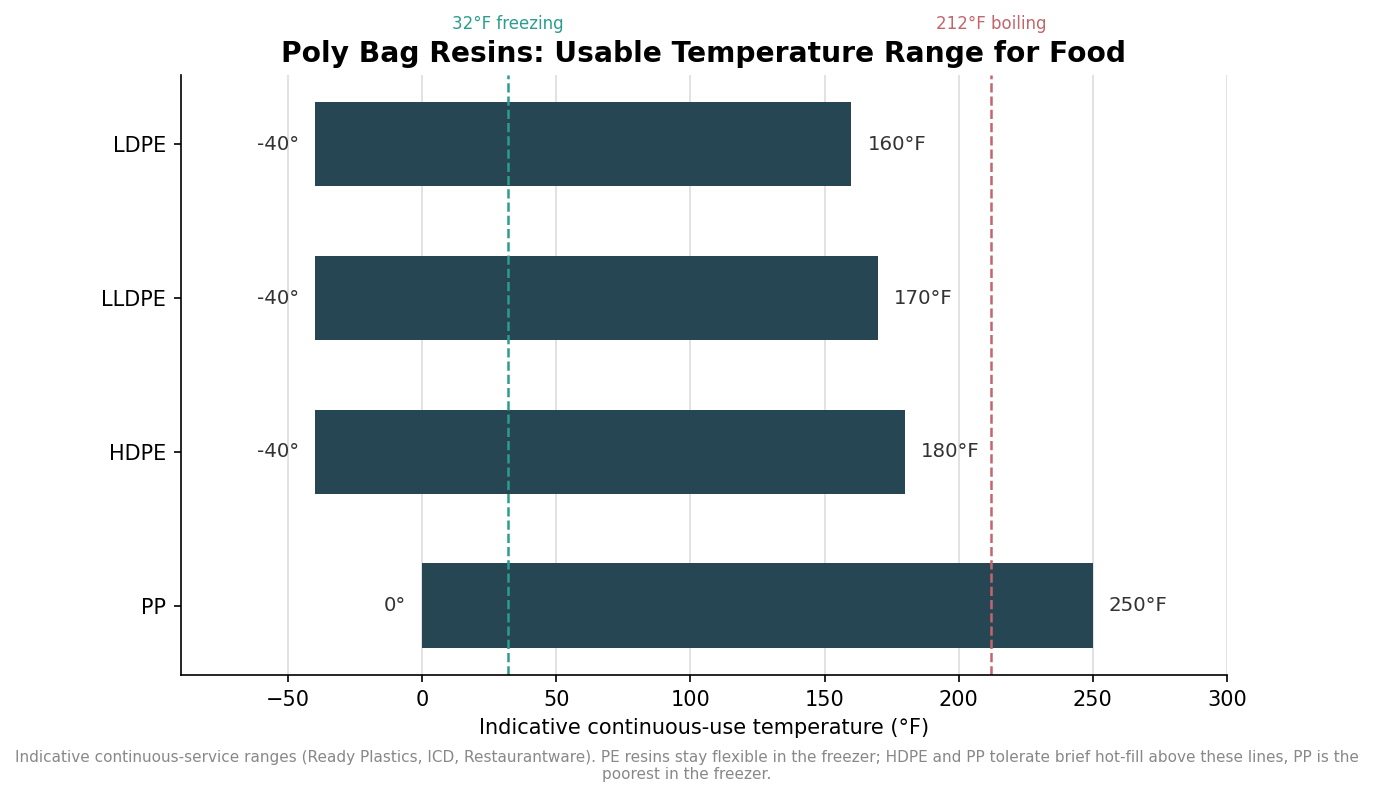
The practical reading is to match the resin to the coldest and hottest point the bag will actually see. LDPE is comfortable to roughly 160°F in continuous use, HDPE to around 180°F, and both remain usable in the freezer. Under 21 CFR 177.1520, compliant polyethylene can contact non-fatty foods up to boiling temperature, but that is a compliance statement, not a license to steam-sterilize an LDPE bag, which sits above its mechanical service range. If a bag will be frozen and later reheated, say so up front, because no single default resin is ideal at both ends of that swing.
Mistake four: under- or over-speccing the gauge
Gauge, measured in mils, is where buyers waste money in both directions. Spec too thin and a freezer bag cracks at temperature or a heavy product punctures the film; spec too thick and you pay for material a produce bag never needed. Food applications sort into fairly predictable gauge bands, and knowing where your product falls keeps the quote honest.
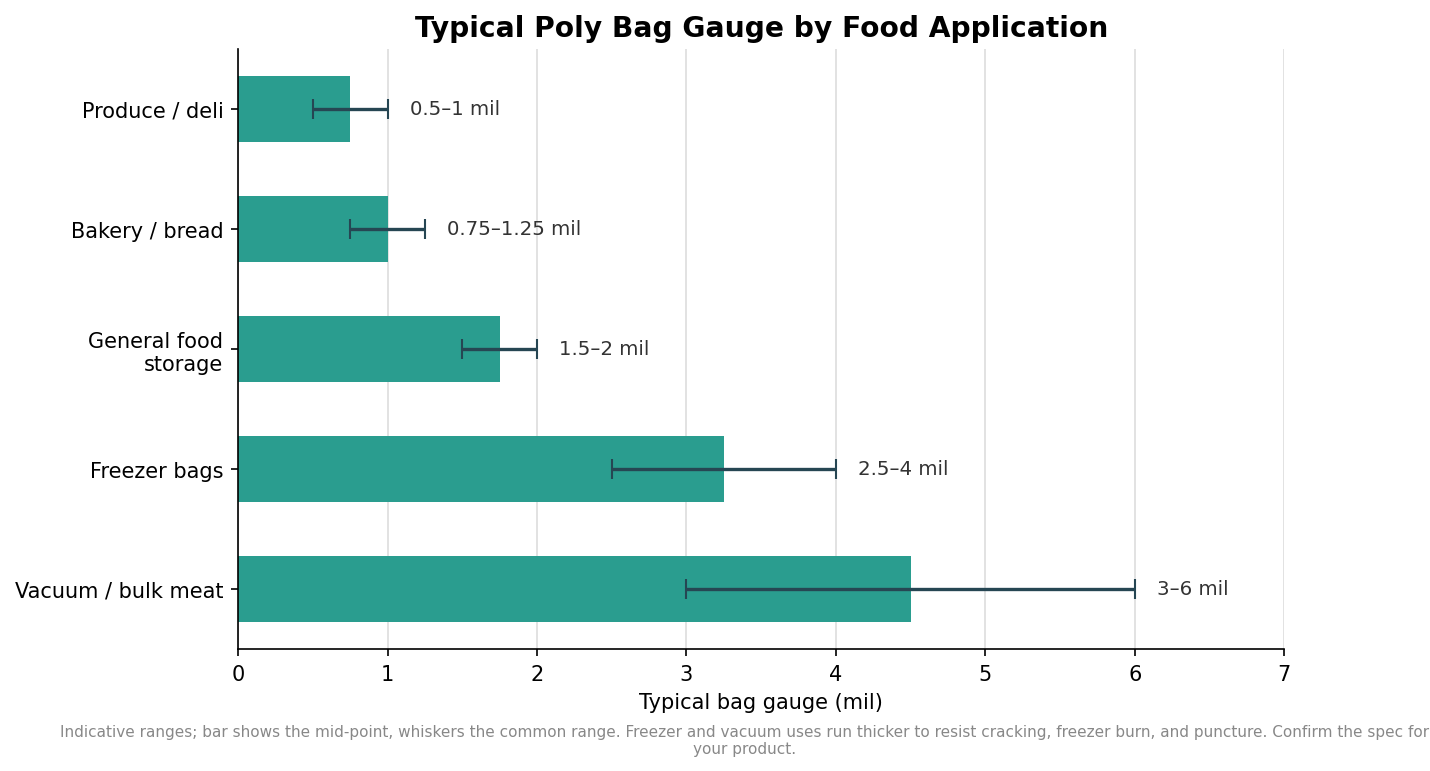
Thin films in the half-mil to roughly one-mil range suit produce, deli, and bakery uses where the bag is a light, short-lived wrapper. General food storage tends to sit around one and a half to two mils. Freezer bags step up to roughly two and a half to four mils to resist cracking and freezer burn, and vacuum or bulk applications such as portioned meat run thicker still, commonly three to six mils, to survive handling and the seal. Treat these as starting ranges and confirm the exact gauge against your product weight, edges, and whether the bag is sealed or simply closed, but do not let a supplier quote you a single gauge for wildly different jobs.
Mistake five: using a bag outside its rated conditions
A compliant bag is only compliant for the conditions it was made for. Fatty and oily foods interact with plastic differently than dry or watery ones, and the regulation treats those contact conditions separately, so a bag fine for dry goods is not automatically fine for hot, greasy food. The reason the rule cares about all of this is migration, the slow transfer of trace substances from the plastic into the food, which rises with heat, fat, and contact time; the conditions of use in the regulation exist precisely to keep that transfer within safe limits. The other common error is reuse: single-use food bags are validated for a single contact, and washing and refilling them, or microwaving a bag never rated for heat, moves the product outside anything the manufacturer tested. Before you buy, describe the real job to your supplier, including the food type, the temperature range, whether it is fatty, and how the bag closes, so the compliance documentation actually matches how the bag will be used.
None of this makes ordering food-grade bags hard; it just makes the specification worth writing down. Confirm 21 CFR 177.1520 compliance in writing, insist on virgin resin and food-grade colorants, match the resin to your temperature range and the gauge to your product, and state the real contact conditions. Get those four things on the purchase order and the bag that arrives will be food-safe in fact, not just in name.